

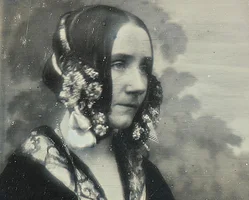

Foundational Innovation and Computational Genesis (1830s–1852)
| Field | Detail |
|---|---|
| Born | December 10, 1815 (Died November 27, 1852, Age 36) |
| Nationality | British |
| Education | Privately tutored in Mathematics & Science (under Mary Somerville, Augustus De Morgan) |
| Known For | First Computer Programmer; Pioneer of Algorithmic Thinking |
| Key Collaborator | Charles Babbage (Analytical Engine) |
| Title Portfolio | Countess of Lovelace; Mathematical Analyst; Visionary Theorist |
| Key Status | #FirstProgrammer, #ComputingPioneer, #MathematicsVisionary, #WomenInSTEM |
Ada Lovelace’s education and social connections introduced her to leading figures of her time, including scientists Andrew Crosse, Charles Babbage, David Brewster, Charles Wheatstone, Michael Faraday, and the novelist Charles Dickens. She drew on these relationships to expand her intellectual horizons. Lovelace characterized her method of thinking as “poetical science” and described herself as an “Analyst (& Metaphysician)”.
At the age of eighteen, her exceptional mathematical ability led to a lasting collaboration and friendship with Babbage, particularly centered on his design of the Analytical Engine. Their first meeting took place on 5 June 1833, when Lovelace and her mother attended one of Babbage’s Saturday evening gatherings, accompanied by their mutual friend and Lovelace’s tutor, Mary Somerville.
Childhood#
Lovelace was the sole legitimate issue of the poet Lord Byron and the reformer Anne Isabella Milbanke
. The marriage was volatile; Lord Byron separated from his wife a mere month after Ada’s birth and died when she was only eight years old. Although she suffered from frequent illnesses during childhood, Lovelace dedicated herself to her studies.
In 1835, she married William King. When King was elevated to the peerage as the 1st Earl of Lovelace and Viscount Ockham in 1838, Ada assumed the title of Countess of Lovelace. The name was selected because Ada was a descendant of the extinct Baron Lovelace line.
Lord Byron had hoped for a “glorious boy” and was disappointed by the birth of a daughter. Named after Byron’s half-sister, Augusta Leigh, she was generally called “Ada.” On 16 January 1816, at Lord Byron’s insistence, Lady Byron took their five-week-old daughter to her parents’ home at Kirkby Mallory. Although English law formally granted custody to fathers, Byron did not fight for his parental rights, though he requested updates on his daughter’s welfare.
Reluctantly signing the deed of separation on 21 April, Byron left England days later, never to return. Lady Byron maintained a lifelong campaign against her husband’s perceived immorality, causing Lovelace to become a figure of infamy in Victorian society. Ada had no relationship with her father, who died in Greece in 1824. Her mother was her primary guardian, though Lovelace was not shown a family portrait of her father until her twentieth birthday.
Lovelace’s relationship with her mother was distant; she was frequently raised by her grandmother, Lady Milbanke. Lady Byron, needing to maintain the appearance of a devoted mother to secure custody, wrote anxious letters to Lady Milbanke about Ada’s health, often with instructions to keep the letters as evidence of her maternal concern. In private correspondence, she sometimes referred to Ada impersonally as “it.” Lady Byron also employed friends to surveil Ada for signs of moral deviation; Lovelace resentfully called these observers the “Furies.”
From age eight, Lovelace suffered from severe headaches that affected her vision. In June 1829, a bout of measles left her paralyzed and bedridden for nearly a year; she required crutches until 1831. Despite her physical frailty, she honed her intellectual skills. At age twelve, the future “Lady Fairy” as Babbage later called her decided she wanted to fly. She approached the project with scientific rigor, constructing wings of paper, wire, and feathers, and studying the anatomy of birds to determine proper proportions. She planned to write a book titled Flyology and even considered using steam power to assist flight.
In early 1833, Ada had a brief affair with a tutor and attempted to elope. She was recognized by the tutor’s relatives and returned to her mother, who covered up the incident to avoid scandal.
Adult years#
Lovelace formed a close friendship with her tutor Mary Somerville, who introduced her to Charles Babbage in 1833. Her social circle included scientific luminaries such as Andrew Crosse, Sir David Brewster, Charles Wheatstone, and Michael Faraday, as well as the author Charles Dickens. Following her presentation at Court at age seventeen, she became a “belle of the season,” noted for her brilliant mind. Although John Hobhouse initially described her as “coarse-skinned,” they later became friends.
Ada and William King had three residences and three children: Byron, Anne Isabella (Annabella), and Ralph Gordon. Following Annabella’s birth in 1837, Ada suffered a prolonged illness. In the 1840s, her mother appointed William Benjamin Carpenter as a moral tutor for Ada’s children. Carpenter fell in love with Ada, but she cut off the relationship when his intentions became clear.
Lovelace’s personal life was marked by complexity. In 1841, she learned that her father had also fathered her half-sister, Medora Leigh, through an incestuous relationship with Augusta Leigh. Ada did not blame her father, but rather Augusta. In the late 1840s, she was surrounded by rumors of affairs and lost over £3,000 gambling on horses. She formed a syndicate with male friends to create a mathematical model for betting, which failed disastrously, leaving her in significant debt. She also maintained a secretive relationship with John Crosse, son of Andrew Crosse, who destroyed their correspondence after her death.
Education#
Lovelace’s mathematical ability became apparent in 1832. Her mother, obsessed with rooting out any “Byronic insanity,” ensured Ada was tutored in mathematics and science—unusual for women of the era. Her tutors included William Frend and Mary Somerville. Later, the mathematician Augustus De Morgan guided her through advanced calculus, including the study of Bernoulli numbers. De Morgan believed she had the potential to become “an original mathematical investigator of first-rate eminence.”
Lovelace viewed her work through a unique lens she called “poetical science.” She often used metaphorical language to describe mathematical concepts, comparing algebraic transformations to “sprites and fairies.” She believed that intuition and metaphysics were essential for exploring the “unseen worlds” of science.
Death#
Lovelace died on 27 November 1852 at the age of 36 from cervical cancer
. During her final months, Lady Byron restricted access to Ada, excluding her friends. Under her mother’s influence, Ada underwent a religious conversion. She confessed a secret to her husband on 30 August which caused him to abandon her bedside. She was buried, at her request, beside her father at the Church of St. Mary Magdalene
in Hucknall.
Work#
Lovelace maintained a strong interest in the scientific trends of her time, including phrenology and mesmerism.
She aspired to create a “calculus of the nervous system” to mathematically model how the brain produces thought. In pursuit of this, she visited electrical engineer Andrew Crosse to learn about experimentation. Although she drafted a review of Baron Karl von Reichenbach‘s work on magnetism, it was never published.
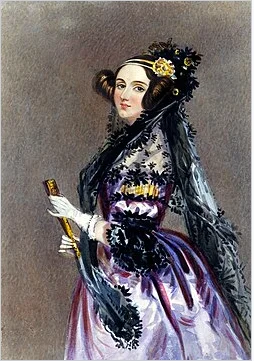
The analytical engine#
Lovelace met Charles Babbage in June 1833 and was immediately captivated by his prototype for the Difference Engine. Babbage, impressed by her analytical skills, dubbed her “The Enchantress of Number.”
In 1840, Babbage lectured on his Analytical Engine at the University of Turin. Luigi Menabrea published a transcript of the lecture in French. In 1843, Lovelace translated this paper into English, augmenting it with seven explanatory notes (labeled A through G) that were three times the length of the original text. These notes explained how the Analytical Engine differed from the Difference Engine and were well received by scientists like Michael Faraday.
First computer program#
“Note G” contained a detailed method for calculating a sequence of Bernoulli numbers using the Analytical Engine. Because this algorithm was a complete set of instructions specifically designed for a machine, it is widely cited as the first published computer program. Although Babbage had written earlier unpublished notes, Lovelace’s work is considered the most sophisticated and complete.
Controversy#
Historians have debated the extent of Lovelace’s contribution. Some, like Allan G. Bromley, argue that Babbage prepared the programs and Lovelace merely detected a bug.
Others, like Stephen Wolfram, contend that while Babbage provided the mechanical context, Lovelace was the “driver” of the work and provided a clear exposition of the machine’s abstract operation that Babbage never achieved.
Visionary insight
Lovelace’s most significant contribution was her vision of the machine’s potential. She realized that the engine could manipulate symbols other than numbers if they were converted into data. She famously wrote:
“The Analytical Engine might act upon other things besides number… Supposing, for instance, that the fundamental relations of pitched sounds… were susceptible of such expression… the engine might compose elaborate and scientific pieces of music of any degree of complexity or extent.”
This insight that a computer could be a General Purpose machine rather than just a calculator anticipated the modern digital age by a century. She drew a parallel to the Jacquard loom, noting that the engine “weaves algebraic patterns just as the Jacquard loom weaves flowers and leaves.”
References#
- Turney, C. (1972). Byron’s Daughter: A Biography of Elizabeth Medora Leigh. Scribner.
- Moore, D. L. (1977). Ada, Countess of Lovelace: Byron’s Legitimate Daughter. John Murray.
- “Byron, George Gordon.” Oxford Dictionary of National Biography.
- Woolley, B. (1999). The Bride of Science: Romance, Reason, and Byron’s Daughter. Macmillan.
- Toole, B. A. (1998). Ada, the Enchantress of Numbers: Prophet of the Computer Age. Strawberry Press.
- Beevers, S. (1988). Ada Lovelace: A Life.
- Stein, D. (1985). Ada: A Life and a Legacy. MIT Press.
- Baum, J. (1986). The Calculating Passion of Ada Byron. Archon Books.
- “The Grave of Ada Lovelace.” Hucknall Parish Church.
- Gleick, J. (2011). The Information: A History, a Theory, a Flood. Pantheon Books.
- Menabrea, L. F. (1843). Sketch of the Analytical Engine Invented by Charles Babbage. Scientific Memoirs, 3, 666–731. https://www.fourmilab.ch/babbage/sketch.html
- Fuegi, J., & Francis, J. (2003). Lovelace & Babbage and the Creation of the 1843 Notes. IEEE Annals of the History of Computing, 25(4), 16–26. https://doi.org/10.1109/MAHC.2003.1253887
- Bromley, A. G. (1990). Difference and Analytical Engines. In W. Aspray (Ed.), Computing Before Computers (pp. 59–98). Iowa State University Press.
- Wolfram, S. (2016). Idea Makers: Personal Perspectives on the Lives & Ideas of Some Notable People. Wolfram Media.











Community involvement is essential for successful conservation. Local people, who often depend on forests for their livelihoods, play a significant role in managing these resources sustainably. Education and awareness programs help foster a sense of ownership, ensuring that forests are protected and preserved for future generations.
Engaging local communities is vital for successful conservation efforts. Since many depend on forests for their livelihoods, they are key players in sustainable resource management. Raising awareness and providing education empower these communities, fostering a shared commitment to protect forests for the future.
This was an intriguing article! I appreciate how it captures the essence of modern intellectuals and their diverse thoughts. The analysis was insightful and made me reflect on how these thinkers influence our current world. It’s not often that we get such a deep dive into the minds of today’s intellectuals.
Thank you for your thoughtful feedback! I’m glad to hear that the article resonated with you and sparked reflection. Exploring the ideas of modern intellectuals is always fascinating, especially when considering their impact on our world today.
Thank you for your kind words! I’m glad the article resonated with you. It’s always fascinating to explore the thoughts of modern intellectuals and their influence on our world. I appreciate you taking the time to reflect on these ideas. If there are specific topics or thinkers you’d like to see more of, feel free to share!
I’m so glad you found the article intriguing! The diverse perspectives of modern intellectuals truly shape how we see the world, and it’s rewarding to explore their impact in depth. It’s always inspiring to hear how others interpret these complex ideas. If you have any specific thinkers or topics you\’d like to dive deeper into, I’d love to hear your suggestions!
Comments are closed.