


Serena Williams
American tennis player Serena Jameka Williams was born on September 26, 1981. The Women's Tennis Association (WTA) placed her as the world No. 1 in women's singles for 319 weeks, which is the third-longest ever, and she concluded the year as the top player five times.

Serena Williams was born on September 26, 1981, in Saginaw to Oracene Price and Richard Williams. She is the youngest of five daughters and the younger sister of fellow tennis champion Venus Williams.
Her father, Richard Williams, designed a detailed plan for his daughters’ tennis careers before they were even born. The family later relocated to Compton, where Serena and Venus trained on public courts. Despite financial hardship and exposure to racial discrimination at junior tournaments, their parents remained their primary coaches.
At age nine, the family moved to West Palm Beach so the sisters could attend the academy of Rick Macci. By 1991, Serena had compiled an impressive 46–3 junior record and ranked No. 1 among under-10 players in Florida.
Professional Debut and Early Career (1995–1998)
Serena turned professional in 1995. After limited tournament appearances early on, she made a breakthrough at the 1997 Ameritech Cup in Chicago, defeating top-10 players including Mary Pierce and Monica Seles, becoming the lowest-ranked player in the Open Era to beat two top-10 opponents in one tournament.
In 1998, she reached multiple quarterfinals and won mixed doubles titles at both Wimbledon and the US Open, signaling her growing versatility.
1999: First Grand Slam Title#
Serena captured her first Grand Slam singles title at the US Open in 1999, defeating world No. 1 Martina Hingis in the final. With that victory, she became the second African-American woman to win a Grand Slam singles championship in the Open Era.
She finished the season ranked world No. 4.
2002–2003: The First “Serena Slam”#
Between the 2002 French Open and the 2003 Australian Open, Williams won four consecutive Grand Slam singles titles—each final against Venus—achieving a non-calendar-year Grand Slam dubbed the “Serena Slam” .
She also reached world No. 1, becoming only the third African-American woman to hold that ranking.
During this period, her aggressive baseline power, dominant serve, and athletic movement reshaped expectations in women’s tennis.
Injuries and Comeback (2004–2007)#
From 2004 onward, injuries—including knee and ankle issues—interrupted her dominance. She dropped out of the top 10 for the first time since 1999.
In 2007, ranked No. 81 and unseeded at the Australian Open, she mounted one of the sport’s most remarkable comebacks, winning the title convincingly and claiming her eighth Grand Slam singles trophy. The victory reestablished her as an elite contender.
2008–2010: Return to World No. 1#
In 2008, Williams won her third US Open singles title and returned to the world No. 1 ranking.
She and Venus also won Olympic doubles gold medals at both the 2000 Sydney Games and 2008 Beijing Games.
By 2009, Serena had reclaimed the Australian Open title and surpassed records for prize money earnings in women’s sports.
2011–2013: Career Golden Slam and Renewed Dominance#
After suffering serious health complications in 2011, including a pulmonary embolism, Williams returned to elite competition.
In 2012, she won Wimbledon and secured Olympic singles gold in London, completing a Career Golden Slam in singles. She also earned doubles gold with Venus.
In 2013, she claimed her 17th Grand Slam singles title at the US Open and finished as year-end world No. 1 for the third time.
2014–2015: Second “Serena Slam”#
Williams dominated again from 2014 to 2015, winning four consecutive majors to complete a second “Serena Slam”.
At the 2015 French Open, she secured her 20th Grand Slam singles title. At Wimbledon 2015, she captured her 21st. Her 23rd Grand Slam title came at the 2017 Australian Open, surpassing Steffi Graf’s Open Era record of 22.
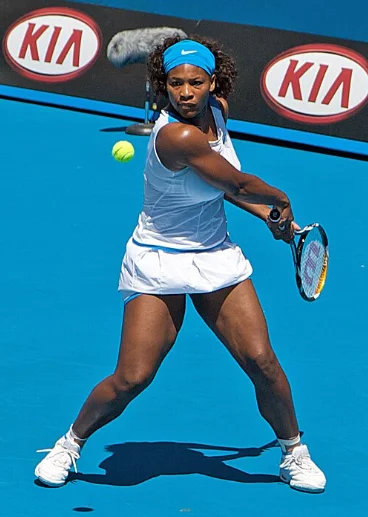
Pregnancy, Return, and Final Years (2017–2022)#
Williams revealed in April 2017 that she was pregnant, meaning she had won the 2017 Australian Open while expecting. She gave birth in September 2017 and later returned to professional competition.
Although she reached four Grand Slam finals after returning, she did not capture another major title.
In 2022, she announced her intention to “evolve away” from professional tennis and played her final match at the US Open.
Doubles Achievements with Venus Williams#
Venus Williams and Serena won 14 Grand Slam doubles titles and were undefeated in major finals as a pair.
They also secured three Olympic doubles gold medals, tying the all-time record.
Serena is the only player—male or female—to complete three Career Golden Slams (one in singles and two in doubles).
Playing Style and Influence#
Williams’ game was built around:
- A powerful first serve
- Aggressive baseline play
- Mental resilience
- Exceptional athleticism
Her rise, alongside Venus, ushered in a new era emphasizing strength and speed on the WTA Tour.
Awards and Financial Impact#
Williams was the world’s highest-paid female athlete in 2016 and 2017. She won the Laureus World Sports Awards Sportswoman of the Year four times and was named Sportsperson of the Year by Sports Illustrated in 2015.
In 2020, Tennis Channel ranked her the greatest women’s tennis player of all time.
References#
[1] Encyclopedia Britannica. Serena Williams.
https://www.britannica.com/biography/Serena-Williams
[2] Women’s Tennis Association. Serena Williams Player Profile.
https://www.wtatennis.com/players/230234/serena-williams
[3] Forbes. Serena Williams Profile.
https://www.forbes.com/profile/serena-williams/
[4] International Tennis Federation. Grand Slam Records & Statistics.
https://www.itftennis.com
[5] International Olympic Committee. Serena Williams – Olympic Results.
https://olympics.com/en/athletes/serena-williams







Community involvement is essential for successful conservation. Local people, who often depend on forests for their livelihoods, play a significant role in managing these resources sustainably. Education and awareness programs help foster a sense of ownership, ensuring that forests are protected and preserved for future generations.
Engaging local communities is vital for successful conservation efforts. Since many depend on forests for their livelihoods, they are key players in sustainable resource management. Raising awareness and providing education empower these communities, fostering a shared commitment to protect forests for the future.
This was an intriguing article! I appreciate how it captures the essence of modern intellectuals and their diverse thoughts. The analysis was insightful and made me reflect on how these thinkers influence our current world. It’s not often that we get such a deep dive into the minds of today’s intellectuals.
Thank you for your thoughtful feedback! I’m glad to hear that the article resonated with you and sparked reflection. Exploring the ideas of modern intellectuals is always fascinating, especially when considering their impact on our world today.
Thank you for your kind words! I’m glad the article resonated with you. It’s always fascinating to explore the thoughts of modern intellectuals and their influence on our world. I appreciate you taking the time to reflect on these ideas. If there are specific topics or thinkers you’d like to see more of, feel free to share!
I’m so glad you found the article intriguing! The diverse perspectives of modern intellectuals truly shape how we see the world, and it’s rewarding to explore their impact in depth. It’s always inspiring to hear how others interpret these complex ideas. If you have any specific thinkers or topics you\’d like to dive deeper into, I’d love to hear your suggestions!
Comments are closed.